
The French Wealth Tax 2026 (IFI): Essential Guide for Non-Residents
Welcome to Worldwide Property Co.’s guide to the French Wealth Tax (IFI) for 2026. Designed specifically for foreign buyers navigating the property acquisition process in France, this guide delves into the essential aspects of the French Wealth Tax (IFI), empowering you to make informed decisions and ensure regulatory compliance.

Understanding the French Wealth Tax (IFI)
The IFI, also known as the French Real Estate Wealth Tax, levies an annual tax on the net value of real estate assets. Net value is the difference between the current value and any mortgage or loans secured against the property, also known as the equity in the property.
Introduced in 2018 as the successor to the ISF (Solidarity Wealth Tax), it focuses solely on real estate holdings. While officially termed the Real Estate Wealth Tax (Impôt sur la Fortune Immobilière or IFI), it’s commonly referred to as the French Wealth Tax. IFI applies to individuals exceeding a specific net wealth threshold.
Who is Subject to French Wealth Tax? Residents vs. Non-Residents
Non-Residents:
If you are not tax resident in France, IFI generally applies only to your French real estate assets, whether held directly or indirectly, once your net taxable French real estate wealth exceeds €1.3 million on 1 January of the relevant year.
French-Residents:
If you are tax resident in France, IFI generally applies to your worldwide real estate assets, subject to the usual exemptions and deductions. Individuals who become French tax resident may, in certain cases, benefit from a temporary regime under which assets located outside France are excluded until 31 December of the fifth year following the year in which French tax residence begins.
Taxable Assets under French Wealth Tax
French Wealth Tax encompasses real estate properties, including houses, apartments, land, and specific real estate-related rights. Notably, the tax applies to the equity of these assets after factoring in deductions and exemptions.
Key points to remember:
- IFI is a household tax, so couples must file a joint declaration.
- Assets held by children below 18 years old must be included.
- French companies you own that hold property must include the underlying property’s value.
- Properties rented for short-term holiday lets, with Para Hotelier may be exempt.
- Commercial properties and buy-to-let investments under LMP status may be exempt under specific conditions.
- Woodlands, rural assets, and specific inheritance situations have exemptions.

Exemptions and Deductions
Several exemptions and deductions can significantly reduce your IFI taxable base, potentially pushing you into a lower tax bracket or even eliminating your tax liability. Here’s a breakdown of key examples:
Principal Residence Exemption
A property that qualifies as your principal residence is not fully exempt. Instead, it generally benefits from a 30% allowance on its market value for IFI purposes, subject to conditions.
That means if a principal home is worth €2 million, the taxable starting value for IFI is usually €1.4 million before taking into account any deductible liabilities.
Debt Deductions
IFI is based on net taxable value, so qualifying liabilities can reduce the IFI base. Official guidance states that, to be deductible, debts must:
- exist and be certain on 1 January
- be borne by a member of the IFI household
- relate to taxable assets.
Examples of liabilities that may be deductible include:
- acquisition loans and mortgages
- certain renovation, improvement, construction or extension debts
- certain unpaid co-ownership charges
- property-related taxes such as taxe foncière
- in some cases, theoretical IFI itself.
There are also limitations:
- family loans are generally not deductible
- some interest-only / in fine loans and loans without capital term have special deduction rules
- debt linked to fully exempt assets is not deductible
- debt linked to partially exempt assets is only deductible in proportion to the taxable part.
Professional Assets
Certain real estate that is treated as a professional asset may be exempt, subject to strict conditions. This includes rental property used in schemes such as Para-Hotelier.
This is an area where careful analysis is needed, particularly where property is used within a trading activity rather than simply held as a passive investment.
To qualify, the property must be essential for your profession, and your professional income must represent a significant portion of your overall income.
Rental income generated from the property does not affect its eligibility for exemption.
Inheritance-Related Exemptions:
You may inherit real estate assets with a reduced taxable base under specific conditions, such as inheriting from a spouse or civil partner. Gifts of property between certain family members may also benefit from reduced taxation.
Other Partial or Full Exemptions
Depending on the circumstances, partial or full relief can apply to certain forestry assets, some rural property, and specific categories of protected property.
Because these exemptions are fact-specific, they should be reviewed alongside a qualified French tax adviser before relying on them.
Calculating Your French Wealth Tax
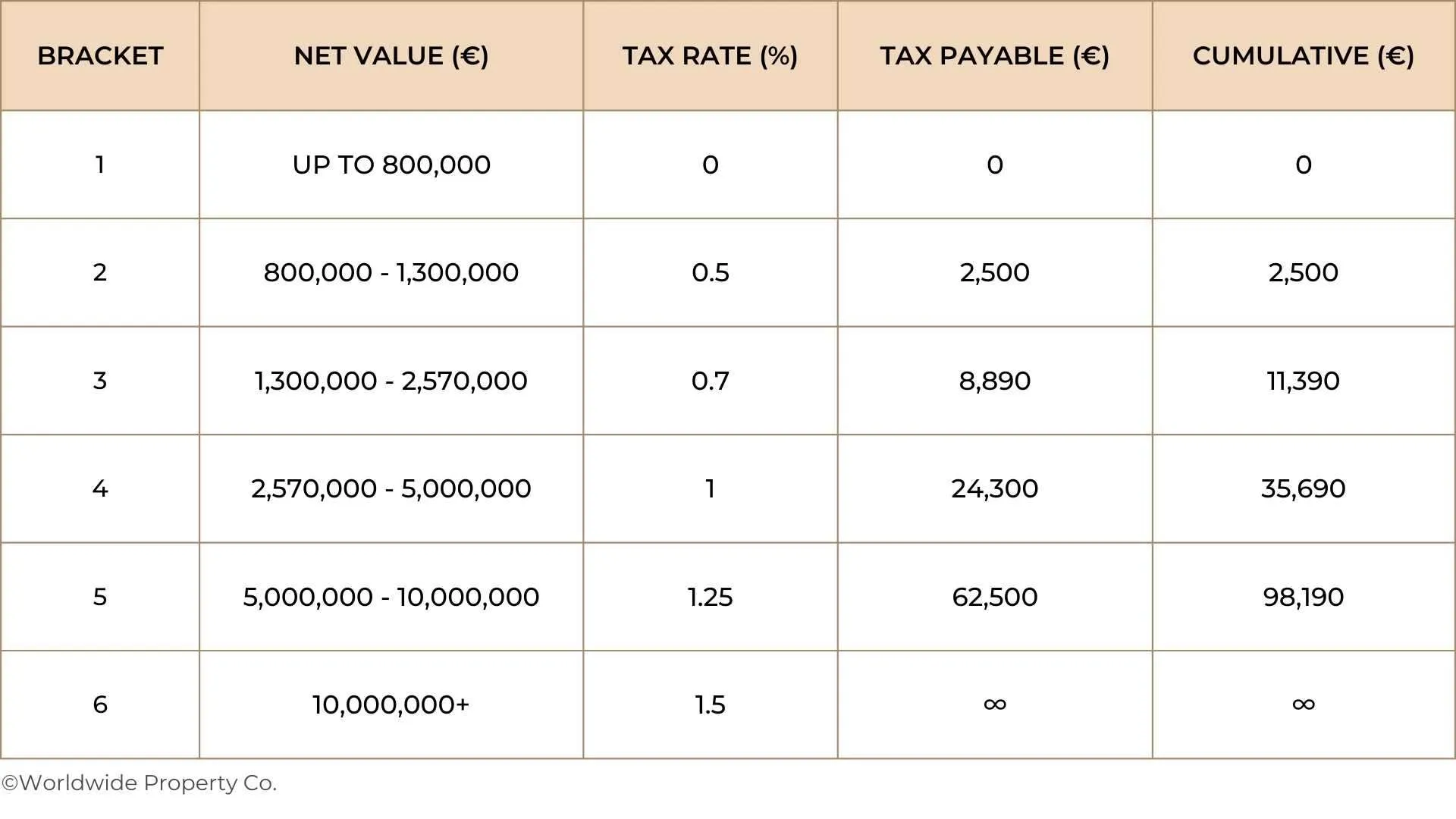
The French Wealth Tax rate follows a progressive structure, ranging from 0% to 1.5%, depending on the total net taxable wealth. See our table below for a rate breakdown of this progressive structure:
French Wealth Tax (IFI) Rates for 2026
Rules for exceeding the €1.3 million threshold:
The tax is not calculated on the entire value exceeding €1.3 million. Each tax bracket applies to a specific portion of the wealth within that bracket.
Example:
If your net taxable real estate wealth is €1.5 million, the calculation is broadly:
- 0% on the first €800,000
- 0.5% on the next €500,000 = €2,500
- 0.7% on the remaining €200,000 = €1,400
Total IFI = €3,900.
Debt Deduction Restrictions Where Taxable Wealth Exceeds €5 Million
There is an additional debt-deduction restriction where the taxable estate exceeds €5 million and the amount of deductible debt exceeds 60% of that value.
In that case, the debt above the 60% threshold is only deductible at 50%.
For example, if taxable wealth is €10 million, 60% is €6 million.
If qualifying debt is €8 million, the first €6 million is deductible in full, but the remaining €2 million is only deductible at 50%, meaning an extra €1 million of deduction rather than €2 million.
Total deductible debt would therefore be €7 million.
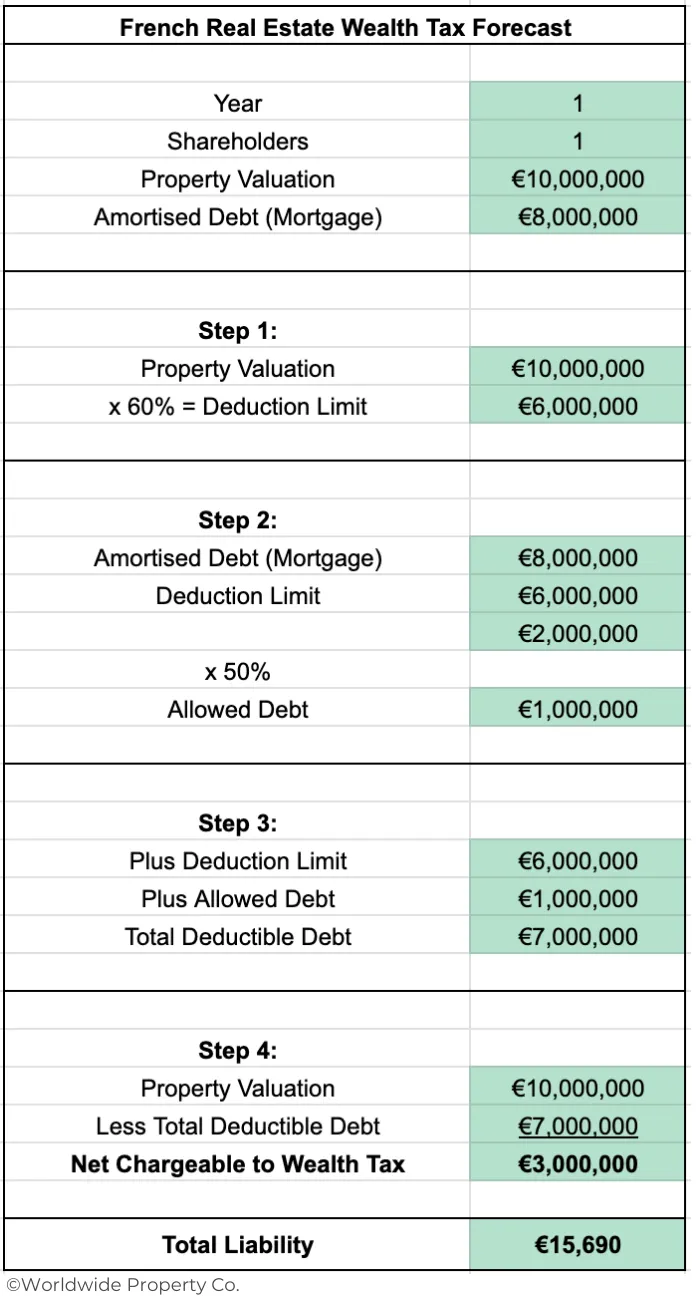
This is calculated in 4 steps:
Step 1
Purchase Price x 60% = Deduction Limit.
Step 2
If the mortgage amount is greater than x, then divide the difference between the Deduction Limit and the mortgage amount in half = Allowed Debt.
Step 3
Deduction Limit + Allowed Debt = Total Deductible Debt
Step 4:
Property Valuation – Total Deductible Debt = Net Equity Chargeable to Wealth Tax
Declaration and Payment
You must declare your IFI liability with your income tax return or using a specific form by June 1st of the tax year. Payment is due in November following the declaration.
Additional Resources:
French tax authorities website: https://www.impots.gouv.fr/accueil
Get Personalised Guidance and Assistance
For personalised guidance and assistance with sourcing real estate and securing mortgages abroad, navigating French property transactions, and understanding tax implications, contact Worldwide Property Co. your trusted buyer’s agent and mortgage brokerage specialising in international property transactions. We are committed to empowering you to make informed decisions and achieve your property investment goals.
Contact us today and book your free consultation with one of our French mortgage specialists.

Disclaimer: This guide is offered for informational purposes only and should not be construed as legal or tax advice. Tax laws and regulations are subject to change, and it’s highly recommended to seek professional advice regarding your specific tax situation.